

Character still counts.
Nicola Sturgeon's memoir reminds us of the reasons she was so popular. It is honest, personal and reveals the toll public life took on this woman who for all her faults actually cared about people.

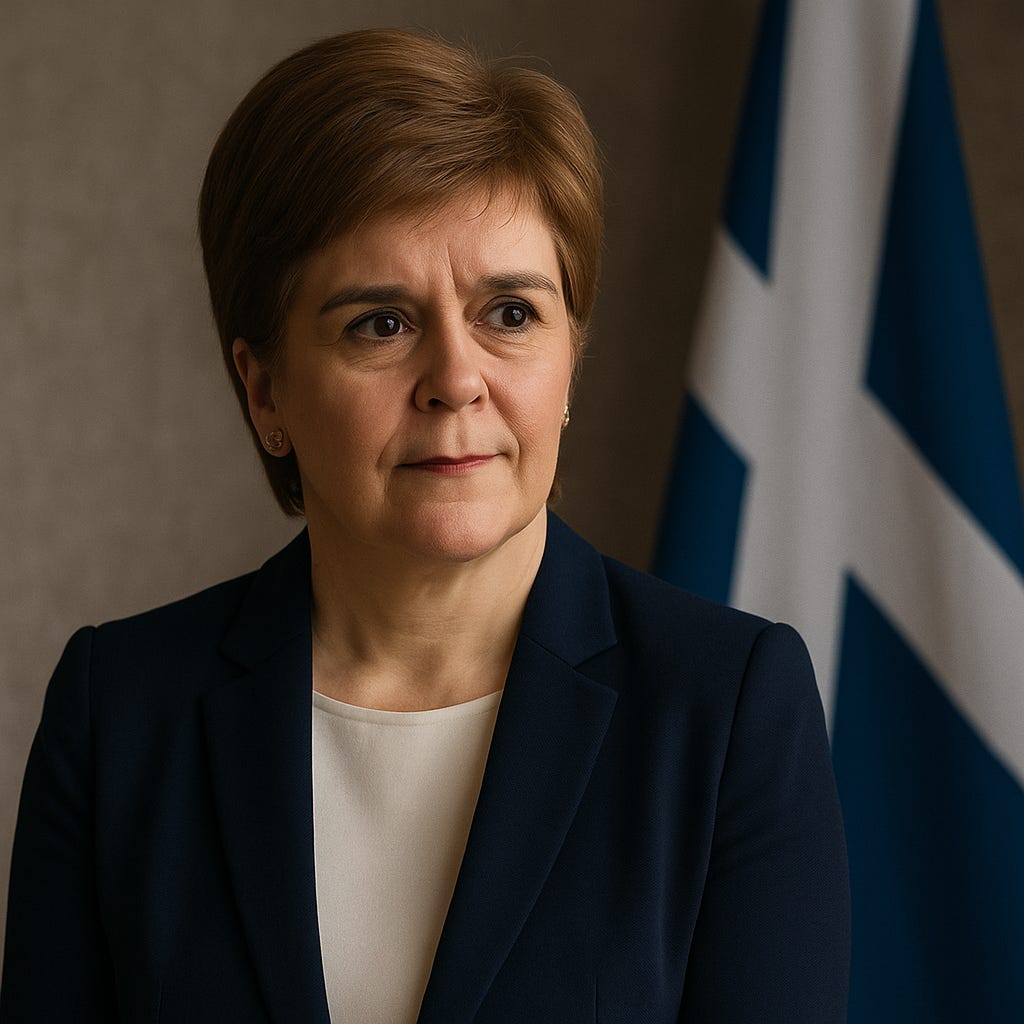
In an age of political cynicism, Nicola Sturgeon was, for a long time, the exception that proved the rule. For years, her popularity in Scotland cut across party lines in a way few modern leaders have managed.
It wasn’t simply that she was a skilled communicator or a formidable debater—though she was both—it was that, for many, she projected qualities increasingly absent in public life: fairness, decency, and a genuine desire to improve the lives of the people she served.
Whatever you thought of her party’s ultimate goal of independence, there was a strong sense, even among opponents, that Sturgeon wanted to make the country better for all its citizens. And that mattered. In fact, for a great many Scots, it mattered more than whether they agreed with her politics.
The Sturgeon era, particularly in its early and middle years, was defined by an unusual political compact: you could disagree with the SNP’s constitutional ambitions and still respect the First Minister.
It was a respect grounded not in policy alignment but in perceived integrity. In a political environment where so much of the electorate had grown tired of evasions, scandals, and empty slogans, Sturgeon’s plain-speaking manner—sometimes blunt to the point of severity—was refreshing.
This was not accidental. Sturgeon understood something fundamental: character is a form of political capital. In a small nation like Scotland, where politics can still feel personal, people weigh not only the manifesto but the moral mettle of the person in charge. And for years, hers seemed beyond reproach.
Part of her appeal lay in how she framed leadership. She spoke often of public service not as a stepping stone or a brand-building exercise, but as a responsibility—a word that became a kind of motif in her speeches.
The public bought it, because her manner reinforced the message. She did not lean on the hollow theatrics so beloved of Westminster; instead, she adopted a matter-of-fact delivery, the style of someone talking with you rather than at you.
During the COVID-19 pandemic, that approach elevated her profile dramatically. Her daily briefings became a fixture in Scottish households. People tuned in not just for the latest restrictions but for reassurance.
In an unprecedented crisis, Sturgeon conveyed empathy without sentimentality, detail without condescension.
Even those sceptical of the SNP’s record admitted she seemed across the detail, in control, and unwilling to treat the public like fools. She projected both competence and care—an almost impossible balance at a time when trust in politicians was in freefall.
And that’s the crux of why her popularity was so resilient: she came across as a human being first, a politician second. Scots saw in her a leader who, whether she was standing in the Scottish Parliament chamber or answering a journalist’s hostile question, was engaged with the substance rather than playing to the cheap seats.
She did not constantly pivot to pre-prepared lines. She did not treat every question as an attack to be parried. There was a willingness, at least in presentation, to engage seriously.
It would be naïve to suggest there was no calculation in this. Sturgeon is a shrewd political operator, one of the most effective of her generation, and her public persona was as carefully cultivated as any leader’s.
But what mattered was that the persona she built resonated with people’s lived sense of her. In politics, perception is reality, and the perception of Nicola Sturgeon was that she was fair-minded, measured, and fundamentally decent.
This is why her support often extended well beyond the pro-independence core. Many unionists in Scotland, while firm in their constitutional position, expressed admiration for her personal qualities. Some went further, saying they wished politicians in their own party could match her in substance and delivery.
That kind of crossover respect is rare.
It happens only when a leader is perceived as being above the petty theatre of partisanship, or at least able to rise above it when the moment demands.
Her politics, of course, were not to everyone’s taste. She was a social democrat to her core, with a belief in the role of government as an active force for social justice. She championed progressive policies on issues like childcare expansion, mitigating the so-called “bedroom tax,” and introducing the Scottish Child Payment to tackle child poverty.
Even where the outcomes fell short, the intent was visible, and for many Scots, intent matters. In a world where so much of politics feels transactional and cynical, intent is read as a measure of character.
It’s here that we see the heart of Sturgeon’s enduring popularity: the belief that she meant what she said. That her actions were grounded in values rather than in personal gain. Whether she was introducing new welfare measures or defending Scotland’s right to determine its own future, there was a through-line: she could be trusted to act in what she genuinely believed was the public interest.
And even those who thought she was wrong could respect that.
Contrast that with the leadership churn at Westminster, where Prime Ministers have come and gone in rapid succession, felled by their own dishonesty, hubris, or incompetence. Against that backdrop, Sturgeon’s steadiness was an asset. She became a fixed point in Scottish political life, someone you might not vote for, but who you knew would be there, visible, and accountable.
That said, her years in office were not without controversy.
The most damaging politically was the Alex Salmond scandal, which became a deeply personal and public rift between two of the SNP’s most prominent figures. In 2018, allegations of sexual misconduct were made against her predecessor. The Scottish Government’s investigation—conducted under Sturgeon’s leadership—was later ruled unlawful due to procedural flaws, resulting in a large payout to Salmond.
A parliamentary committee concluded that Sturgeon had given an inaccurate account of when she first learned about the complaints, while an independent ministerial inquiry cleared her of breaching the ministerial code, citing a genuine failure of recollection rather than deliberate deception.
Sturgeon herself has described the breakdown with Salmond as a painful rupture, and in her memoir has even suggested he may have sought to control the narrative by orchestrating leaks—an accusation strongly denied by his allies.
As the Salmond fallout continued, another storm gathered in the form of allegations against her husband, Peter Murrell, the SNP’s then-chief executive. Murrell was later charged with embezzlement in connection with a long-running investigation into the party’s finances, focusing on funds raised for a second independence referendum and a personal loan he made to the party.
Sturgeon, though never charged, was questioned under caution during the inquiry—a process she has described as “like a form of mental torture.” She has since spoken openly about the psychological toll of these events, a rare public glimpse into the personal costs of political life at the highest level.
These episodes undoubtedly dented public trust in her government, creating a perception that the SNP under her leadership was not as transparent or unassailable as it had once appeared.
But crucially, the personal reservoir of respect she had built up over years meant that even in the midst of these crises, her own standing with the public remained remarkably strong. Polling consistently showed that while some confidence in the SNP’s governance had waned, Sturgeon herself was still regarded as one of the most capable and trustworthy leaders in the UK.
It is telling that the real collapse in the SNP’s polling numbers came only after she stepped back from frontline politics.
Whatever the turbulence of her final years, Sturgeon remained for many voters the SNP’s greatest electoral asset—someone who could hold together a broad coalition of support through sheer credibility. Her departure removed that anchor, and the party has yet to find a successor able to command the same mix of respect and affection.
It’s worth acknowledging, too, the way in which gender politics was wielded against her. Her tenure coincided with an increasingly toxic public discourse on issues of gender identity, women’s rights, and trans inclusion.
Her government’s gender recognition reforms became a flashpoint—not just a policy dispute, but a culture war battleground. Opponents portrayed her as “obsessed” with identity politics, a framing designed to undermine her moral authority.
Supporters saw her position as principled, a refusal to abandon vulnerable minorities despite the political risks. Regardless of where one stood on the policy, the ferocity of the debate and the way it was weaponised added to the pressures on her leadership.
Over time, the cumulative weight of political wear-and-tear began to show. Years in high office inevitably invite fatigue, both for the leader and the public.
The pandemic that had cemented her national profile also left political and personal scars. The constant firefighting, the polarising constitutional debate, and the grinding demands of government narrowed the political space she could operate in.
Her approval ratings, once untouchable, began to soften. Some of that was down to policy frustrations. Some of it was the inescapable fact that no leader can retain peak popularity indefinitely. And some of it was the success of opponents in reframing her image—not as the fair-minded national leader, but as a calculating political figure whose time had passed.
Yet even as her political capital declined in her final months in office, the underlying respect endured. You could see it in the reactions to her resignation: tributes from allies and opponents alike, many acknowledging not just her political skill but her personal decency. There was a recognition that Scotland was losing a leader who had genuinely tried to live up to the responsibilities of the office, even in the face of extraordinary personal and political pressure.
The arc of Nicola Sturgeon’s career will be debated for years to come.
Analysts will pore over her record on independence, her domestic policy successes and failures, and the controversies that marked her later years. But for many ordinary Scots, her tenure will be remembered less in terms of policy scorecards and more in terms of tone, trust, and character.
In a political age where those qualities are in perilously short supply, that is no small legacy. Politics is as much about trust as it is about policy. Voters will forgive mistakes if they believe those mistakes were honest. They will not forgive being taken for fools.
Sturgeon’s political brand was built on the idea that she respected the electorate enough to level with them. Whether in crisis or in the day-to-day grind of governing, she treated people as partners in the conversation, not as an audience to be managed.
That’s why, for so long, she towered above other leaders in public approval ratings. It wasn’t simply SNP voters keeping her afloat—it was a coalition of goodwill from across the spectrum, built on the simple perception that she was, in essence, a good person trying to do the right thing. In an era where cynicism is the default, that’s political gold.
For years, Nicola Sturgeon personified that truth in Scotland.
She was, to many, a leader you didn’t have to agree with to admire. And in our present political climate, that is as rare as it is valuable.
Brilliant piece James. 🙌
A highly manipulative individual who delivered little of substance, and now trying to devise a new career, having done considerable damage to the standing of her party.